

DeFi Lending, in Plain English
A practical introduction to collateral, borrowing, LTV, liquidation thresholds, and why portfolio health matters.
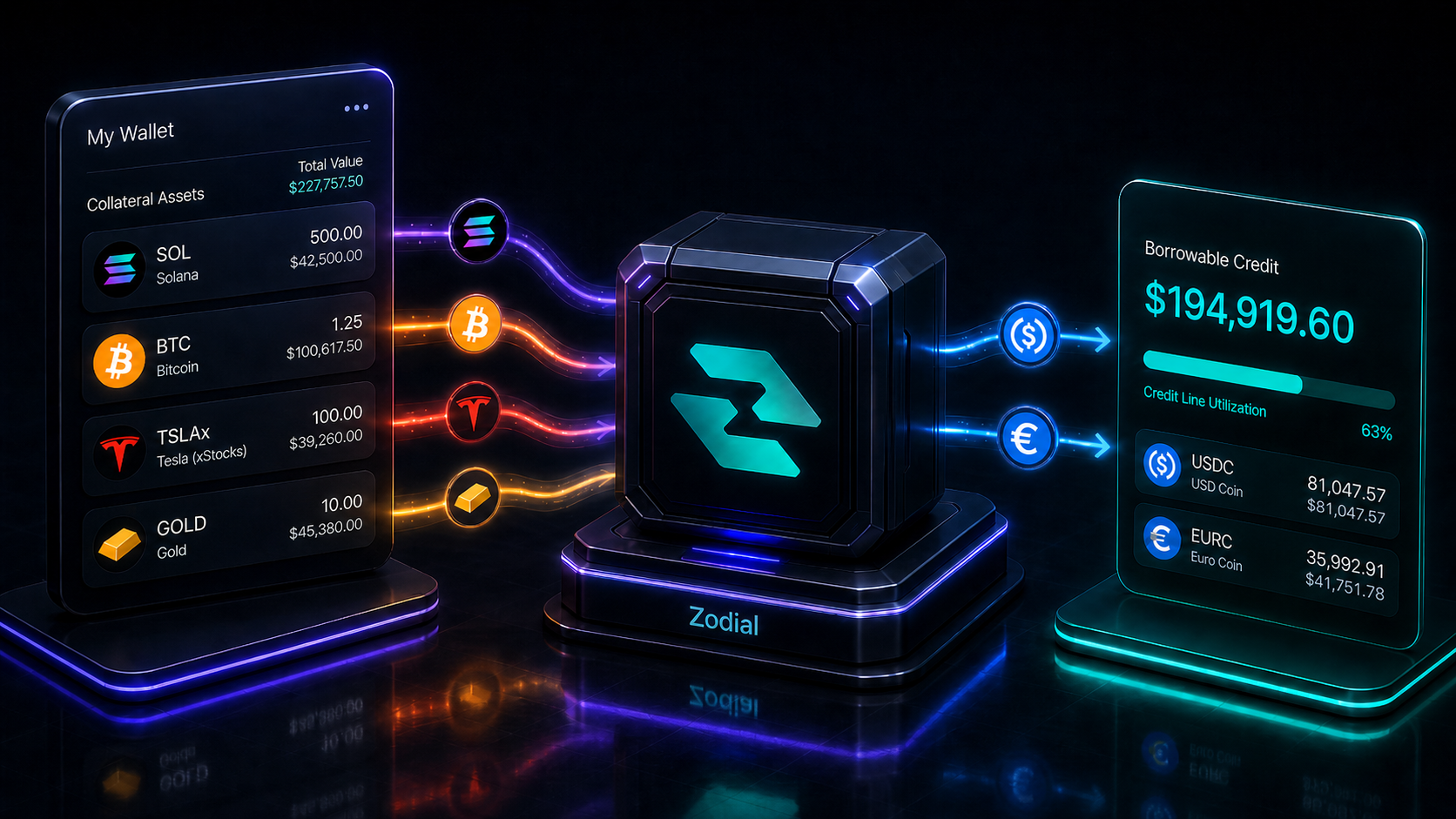
Most people meet DeFi lending through a simple promise: deposit assets, earn yield, and borrow without asking anyone for permission.
That is true, but it is only the surface. Lending is also the credit layer behind leverage, liquidity management, market making, and many of the positions users build onchain. If DeFi is going to support real portfolios, lending cannot stay trapped in single-asset thinking.
This series starts from the basics and ends with the model behind Zodial: portfolio-native lending powered by pairwise risk and linear optimization.
The basic lending loop
A lending protocol has two sides.
Lenders deposit assets into a pool. Borrowers deposit collateral and borrow assets from that pool. The protocol sits between both sides and enforces one invariant: borrowed assets must stay sufficiently backed by collateral.
For the user, the flow looks simple.
Collateral
Deposit assets
Credit
Borrow line
Health
Safety buffer
Collateral creates borrow power. Debt consumes it. Health is the remaining buffer.
- Deposit collateral.
- Borrow another asset.
- Keep the account healthy.
- Repay debt or withdraw collateral later.
The protocol does not need to know who you are. It only needs to know whether your collateral can cover your debt.
Core lending invariant
Debt must stay backed by collateral
Collateral, debt, and borrow limits
Assume a user deposits $1,000 of SOL.
If the protocol gives SOL a borrow LTV of 70%, the user can borrow up to $700.
That does not mean borrowing the full $700 is smart. It means the protocol allows it under its current risk settings. If SOL falls, the account gets closer to liquidation. If the debt grows due to interest, the account also gets closer to liquidation.
The simplest mental model is:
- collateral gives you borrow power;
- debt consumes borrow power;
- price movement changes the safety buffer.
LTV and liquidation threshold are not the same
Two numbers matter.
Borrow LTV defines how much debt you can open.
Liquidation threshold defines when the account can be liquidated.
The liquidation threshold is usually higher than the borrow LTV. This creates a buffer between opening a position and becoming liquidatable.
For example, SOL might have:
- 70% borrow LTV;
- 80% liquidation threshold.
With $1,000 of SOL, the user may be able to borrow $700. But if the position becomes risky enough that the debt approaches the liquidation threshold, the protocol can allow liquidators to step in.
Why liquidation exists
Liquidation is not a punishment mechanic. It is how lending protocols protect lenders.
If a borrower’s account becomes unhealthy, a liquidator can repay part of the debt and receive collateral at a discount. This reduces risk for the protocol and helps keep the pool solvent.
Without liquidations, lenders would be exposed to accounts that can no longer cover their debt.
Health factor: the dashboard number users watch
Most lending protocols compress account safety into a health factor or similar score.
A high health factor means the position has room before liquidation. A low health factor means the account is closer to being liquidated.
The exact formula differs by protocol, but the intuition is always the same:
24%
buffer remaining
Current debt load
76% of threshold
Liquidation threshold
100%
The filled segment is current debt load. The unfilled segment is the remaining buffer before the liquidation threshold.
How much valid collateral protection does this account have relative to its debt?
That question sounds simple with one collateral and one debt. It becomes much harder when the user has a real portfolio.
Why this matters for Zodial
A basic lending protocol can ask:
How much can SOL collateral borrow?
Zodial asks a more complete question:
How well does this entire portfolio cover this entire debt basket?
That difference matters because users do not think in isolated markets. They hold SOL, ETH, stablecoins, tokenized stocks, liquid staking tokens, and other assets at the same time. They borrow for liquidity, leverage, hedging, and yield strategies.
The lending engine should understand that.
Takeaway
DeFi lending starts with collateral, debt, LTV, and liquidation. But the hard problem is not opening a loan. The hard problem is measuring whether a real portfolio is healthy.
That is where the next posts go: from basic borrowing, to looping, to portfolio-native credit.