

Pairwise Risk: The Missing Primitive in DeFi Lending
Why every collateral/debt pair deserves its own risk parameters, and how pairwise risk enables portfolio-native lending.
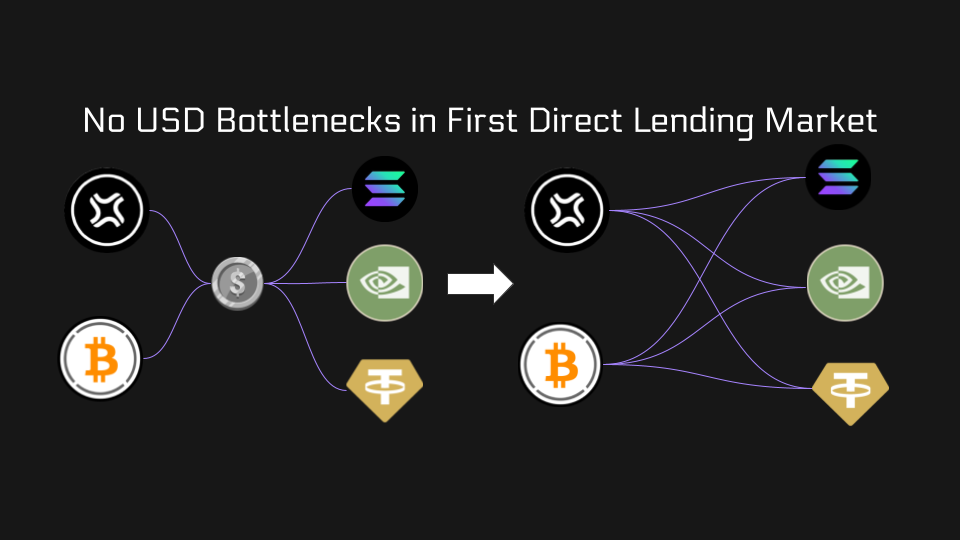
Borrowing USDC against SOL is not the same as borrowing ETH against SOL.
Borrowing USDC against tokenized treasuries is not the same as borrowing SOL against tokenized Tesla.
The relationship between collateral and debt matters. Pairwise risk is the primitive that makes this relationship explicit.
The limitation of one asset number
Many lending systems start with asset-level parameters.
An asset receives a borrow LTV, a liquidation threshold, and maybe caps or penalties. This is simple and useful, but it compresses too much information into one number.
The problem is that collateral quality changes depending on the debt.
USDC collateral is extremely strong against USDC debt. SOL collateral against USDC debt is volatile but liquid. Tokenized equity collateral against USDC debt has different market hours, liquidity, and oracle assumptions. SOL collateral against ETH debt has another profile entirely.
One global number cannot express all of this.
The pairwise model
Pairwise risk assigns parameters to the relationship between a collateral asset and a debt asset.
For example:
- SOL collateral → USDC debt;
- ETH collateral → USDC debt;
- USDC collateral → SOL debt;
- tokenized Nvidia collateral → tokenized Tesla debt;
- tokenized gold collateral → BTC debt.
Each pair can have its own borrow LTV, liquidation threshold, penalty, cap, or disabled state.
Collateral basket
SOL + ETH + RWA
Debt basket
USDC + crypto debt
Health result
Coverage map
The account is not a single ratio. Each collateral asset has a different job against each debt.
Pairwise risk
Collateral quality depends on the debt
A small matrix
A simplified matrix might look like this:
| Collateral / Debt | USDC | SOL | ETH |
|---|---|---|---|
| USDC | 90% | 80% | 80% |
| SOL | 70% | — | 75% |
| ETH | 72% | 75% | — |
These numbers are illustrative, not protocol parameters.
| Collateral | USDC debt | SOL debt | RWA debt |
|---|---|---|---|
| USDC collateral | 84% | 62% | 48% |
| SOL collateral | 70% | 58% | 42% |
| Equity collateral | 55% | 38% | 34% |
The exact values here are illustrative. The primitive is the shape: collateral quality is defined relative to the debt asset.
The important part is the shape. Rows are collateral assets. Columns are debt assets. Every cell answers one question:
How much can this collateral safely support this debt?
Why this is more expressive
Pairwise risk can express relationships that buckets cannot.
It can say that two stablecoins are very strong collateral for each other. It can say that SOL and ETH are related but not identical. It can say that one tokenized stock is acceptable collateral for USDC but only with conservative limits. It can disable a pair entirely if the risk is unclear.
This gives the protocol a richer language.
Why this matters for users
For users, pairwise risk means collateral is not wasted just because it does not fit a single market silo.
A diversified account can receive credit for multiple eligible collateral assets. A hedged position can be evaluated more accurately. A user can borrow against a portfolio instead of trying to manually split assets across different protocols.
The result is not “risk-free leverage.” The result is better risk recognition.
Why this matters for Zodial
Pairwise risk is the base layer of Zodial’s lending model.
The protocol does not only ask how risky an asset is. It asks how useful that asset is for covering each debt in the account.
Once those relationships are defined, the next problem appears: if a user has many collateral assets and many debts, how should coverage be assigned?
That is where Zodial’s portfolio health engine comes in.
Takeaway
Pairwise risk is the missing link between simple lending markets and true portfolio-native credit.
It lets a protocol describe risk at the level where users actually experience it: between the assets they hold and the assets they borrow.