

What Is Looping, and Why Do DeFi Users Do It?
A clear explanation of recursive lending loops, leveraged exposure, yield amplification, and the risk tradeoffs behind them.
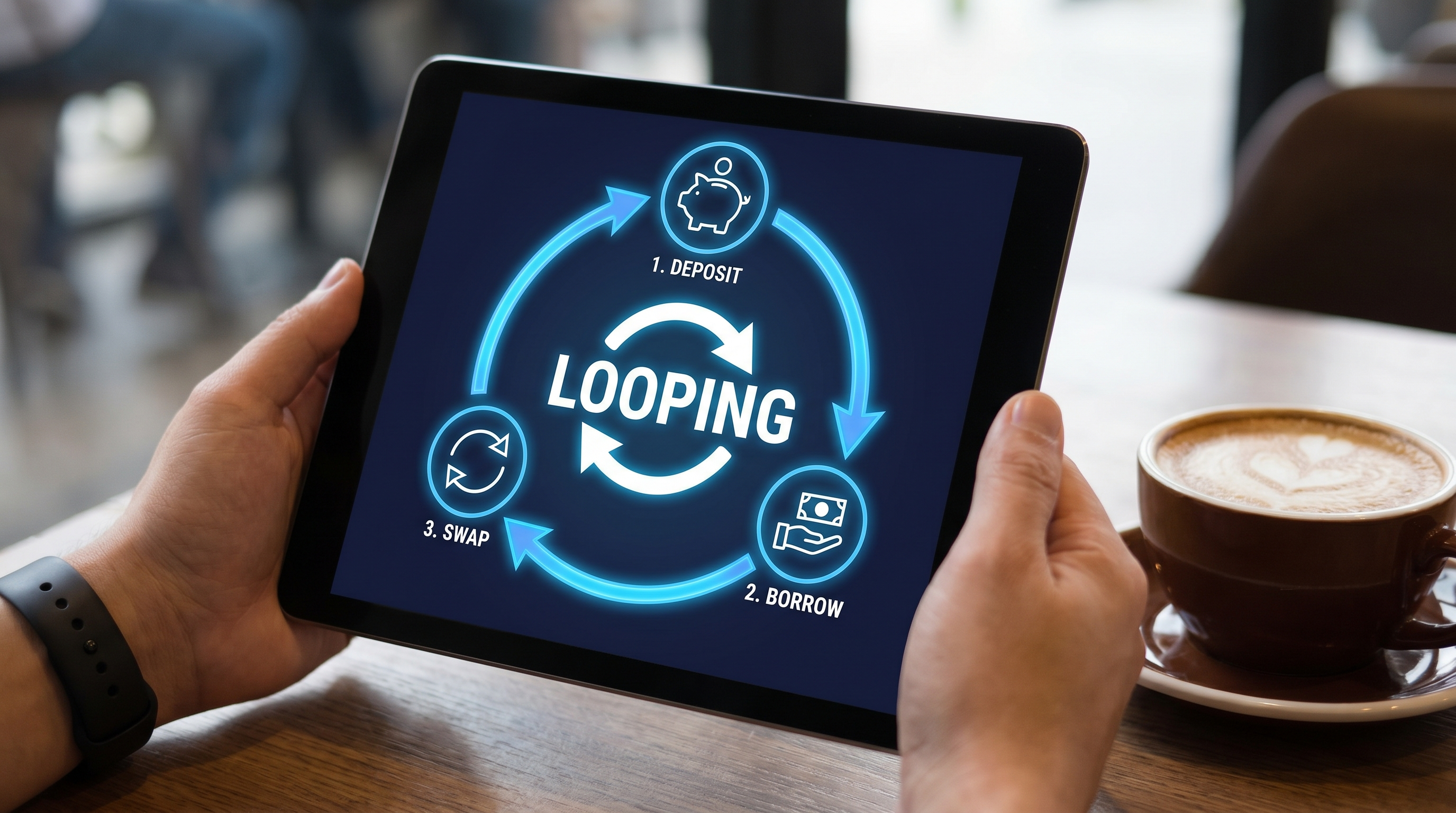
Lending becomes more interesting once users stop treating it as a passive yield product.
One of the most common DeFi strategies is looping: deposit collateral, borrow against it, use the borrowed asset to buy more collateral, deposit again, and repeat. It is the lending-native version of leverage.
Looping is powerful because it uses the same primitive twice: collateral creates borrow power, and borrowed assets can become more collateral. It is also risky because every loop reduces the margin for error.
The basic loop
A simple loop looks like this:
- Deposit SOL as collateral.
- Borrow USDC.
- Swap USDC into more SOL.
- Deposit the new SOL.
- Borrow again.
Collateral
Deposit
Debt
Borrow
Loop
Swap + redeposit
Each pass increases exposure while reducing the margin for error.
After one loop, the user has more SOL exposure than they started with. After several loops, the position behaves like a leveraged long.
If SOL goes up, the user benefits more than a simple spot holder. If SOL goes down, the user gets closer to liquidation faster.
Looping effect
More exposure, less safety buffer
A small example
Start with $1,000 of SOL.
Assume the protocol allows a 60% borrow LTV.
The user deposits $1,000 of SOL and borrows $600 USDC. Then they swap that $600 USDC into SOL and deposit the new SOL. Now the account has $1,600 of SOL collateral and $600 of USDC debt.
The user can borrow again against the additional collateral, though the next borrow is smaller. Repeating this process increases exposure while also increasing debt.
This is why looping feels attractive in rising markets and dangerous in sharp drawdowns.
Why users loop
Users loop for different reasons.
Some want leveraged exposure to an asset. Some want to amplify lending incentives. Some want to farm points. Some want to turn a long-term holding into a more active capital position.
The strategy is not automatically good or bad. It is a tool. The quality of the strategy depends on the assets, risk parameters, liquidity, oracle reliability, and the user’s liquidation buffer.
The hidden cost: path dependency
A looped position is more fragile than a spot position.
With spot SOL, a drawdown hurts, but there is no liquidation. With looped SOL, a drawdown can force the position to unwind at the worst time. The user may lose collateral, pay liquidation penalties, and end up with less exposure after the market recovers.
That makes health management critical.
52%
buffer remaining
Current debt load
48% of threshold
Liquidation threshold
100%
The filled segment is current debt load. The unfilled segment is the remaining buffer before the liquidation threshold.
Users need to know:
- how close they are to liquidation;
- which asset move hurts them most;
- how much debt they can safely carry;
- whether their collateral is concentrated or diversified;
- what happens when markets move quickly.
Why isolated looping is limited
Most looping happens inside narrow asset assumptions.
A protocol may support a SOL loop, an ETH loop, a stable loop, or a liquid staking token loop. These can be useful, but they still treat the user through predefined market rules.
Real users often have more complex portfolios. They may hold SOL, ETH, USDC, tokenized equities, and other assets at the same time. Their risk is not only “SOL went up or down.” Their risk is the combined behavior of the full portfolio against the full debt basket.
A loop that looks risky in isolation may be safer when paired with stabilizing collateral. A position that looks fine in one market may be dangerous when the user’s other exposures are ignored.
How Zodial thinks about loops
Zodial is designed for portfolio-native credit.
Instead of asking only whether one asset can support one borrow, Zodial asks how the entire collateral set covers the entire debt set. That matters for simple leverage loops, but it matters even more when users combine loops with hedges, stable buffers, or tokenized real-world assets.
The goal is not to push users into maximum leverage. The goal is to measure risk more accurately so users can build positions that match how they actually manage capital.
Takeaway
Looping turns lending into leverage. It can be useful, but it compresses the safety buffer and makes risk measurement more important.
The next step is understanding why isolated lending markets struggle to evaluate these positions properly.